Friday, May 4, 2012

Light Rail to the Rescue


Within the United States, there is a heavy consumer preference for automobile transportation.  This weighted preference for automobile transportation has lead to extensive investment by federal, state, and local governments on roads and highways within the United States.

On a consumer preference side, use of personal vehicles and roads account for 96 percent of ground transport passenger miles in the US (Fisher, 554).  As a consequence of this trend in the US, an increasing number of US highways and roads experience very significant traffic congestion.  Unfortunately, increasing problems with congestion come with steep financial losses.  One study, based on congestion trends for 439 selected areas from 1982 to 2007, reports that the costs of traffic congestion for the US is $87.2 billion (in constant 2007 dollars) in wasted time and fuel annually (Triantis). 

With the costs and negative externalities of automobile transportation increasing within the US, metro areas should increasingly look for innovative options to relieve congestion.  One of these options is light rail mass transit.

Fortunately, it has been found that light rail systems can alleviate significant amounts of congestion.  In a 2008 study of congestion within the Twin Cities, it was discovered that I-94 traffic volumes grew steadily between 2000 and 2004, when the Hiawatha Line was under construction.  In 2005, however, traffic volumes along this corridor decreased 2.1 percent.  In 2006, these traffic volumes decreased another 4.3 percent, with particularly large reductions in congestion during peak periods.  These decreases in congestion along I-94 occurred while overall regional vehicle traffic grew.  This indicates that light rail services can significantly reduce automobile traffic volumes on parallel highways (Litman).  Ultimately, this decrease in congestion will lead to decreased expenditures on road construction and maintenance.

Funding for LRT

Beyond support from the federal government for LRT projects in Minnesota, the Transportation Division within the Metropolitan Council has established financial agreements with counties, railroad authorities with property tax revenues, and the State to finance the capital and operational costs associated with the Hiawatha Line and Central Corridor Line.

While transit projects, such as the Hiawatha and Central Corridor light rail lines, do have high capital costs ($715.3 million and $956.9 million, respectively), their potential to significantly reduce highway congestion, and costs associated with highway congestion, cannot be ignored.  This is especially so for the Twin Cities, as it has the second highest rate of congestion growth in the US (TTI).  With the support of federal funding, the Metropolitan Council, Metro Transit, and Mn/DOT should continue to look for ways to form agreements with counties, regional railroad authorities, and the State to expand light rail beyond the Hiawatha and Central Corridor Lines.

Minnesota capital investment & the nonstate match requirement


     Each year, the Minnesota Legislature reviews capital investment projects put forth by state agencies and other public entities. The Minnesota Constitution states that the sale of capital investment (general obligation) bonds must be used to "to acquire and to better public lands and buildings and other public improvements of a capital nature, and to provide money to be appropriated or loaned to any agency or political subdivision of the state for such purposes."
  State agencies often facilitate and filter many of the requests from local governments by proposing ranked project lists to the legislature. Historically, the legislature passes a capital investment bill in even-numbered years that funds over $1 billion of projects. Currently the Minnesota Legislature is proposing a $496 million bonding bill. This proposal includes a plethora of projects such as flood hazard mitigation, higher education asset preservation and replacement, civic centers, and wastewater infrastructure.
Minnesota sells general obligation bonds to pay for capital investment projects that have statewide significance and are approved by the legislature. State officials use debt management guidelines to determine the size and number of projects to fund. 
The U of M and MnSCU are unique in that they have been required to provide a 1/3 financial match since 1992 for new buildings funded by the state.  This nonstate match requirement may not be paid for by state appropriations, which composes a large part of these institutions’ total revenue. In general, the U of M funds their nonstate match requirement through their own sale of bonds or through private donations. MnSCU does not have bonding authority and generally funds their nonstate match with tuition revenue. This is somewhat confusing since tuition revenue is technically considered state revenue.  
     There is one exception to the nonstate match requirement for the U of M and MnSCU: higher education asset preservation and replacement (HEAPR) projects. State statute requires that HEAPR projects be limited to the preservation and replacement of existing campus facilities. This exception was a strategic decisions by the legislature to encourage the U of M and MnSCU to extend the life of existing building and be stewards of existing resources, rather than requesting that new projects be funded. 
          The U of M and MnSCU have the largest inventory of buildings compared to any other public entity.  Because of this inventory, these higher education institutions often have the largest state capital investment requests. The nonstate match helps prioritize these requests. See the breakdown of the U of M's current capital investment request.


Transportation Finance in Williams County, North Dakota

With few topographical disturbances, Williams County in North Dakota is largely divided into one square mile sections by a system of gravel, dirt, and occasionally paved county roads. For a state with an economy that is based on agriculture, these roads are critical to getting those goods from production sites to market. Fortunately, this economic function and related uses do not generate a high level of traffic, so the county road network has traditionally required relatively low levels of capital investment (i.e. dirt and gravel roads) and maintenance. In terms of public finance, these county roads were traditionally paid for by local property taxes, but funding formulas have evolved over the last century to depend more on intergovernmental transfers derived from federal and state fuel and motor vehicle taxes. This correlates with broader shifts in transportation finance in the country.

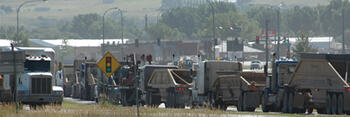
However, the local transportation network is in crisis mode due to oil production in the region. The oil boom has been an economic boon to the region and the state, but it has also entailed daunting challenges. As recently noted in a recent article in Governing magazine:
Drilling each new well requires more than 2,000 truck trips, and the heavy rigs are destroying the roadways. “Simply put, the roads are falling apart in many cases,” says Alan Dybing, a researcher at the Upper Great Plains Transportation Institute, which estimates that fixing the roads will require an investment of more than $900 million over the next 20 years.”
This is a stunning transformation of how this county road infrastructure is used. The infrastructure itself, and the financing structure behind that expenditure, were previously based on a different level of use and a different array of users. Perhaps of equal significance is that the financing system was based on a different calculus of the economic potential of the land in the region. In other words, the optimal tax structure for a transportation system through marginally productive agricultural land is unlikely to be the same for a system through a region extracting billions of dollars of oil deposits.

A solution that enables direct attribution of impact on county roads without enforcement by local law enforcement would be desirable. A minor solution has been proposed in which local law enforcement would get the revenue from enforcing weight limits, and that would be a good start. That proposal implicitly recognizes that the problems related to county road funding are closely related to a subset of users: heavy rigs. These users are causing severe impacts on the road network, and they are working in the industry that is most directly benefiting from the oil boom.

My recommendation is that the State institute a tracking system for heavy rigs. Each rig would be registered and outfitted with a GPS device that would create a record of where it is traveling within the state. At nodes in which these rigs acquire or deposit material (i.e. water, oil, fracking liquid), an electronic record of that event would be created. These materials have known masses, which would make spot enforcement of individual rigs out on the road network a lower concern. The records would create a clear trail of rigs, weights, and routes. This activity could be tied to impact fees, which would be directly tied to the counties impacted by the activity. Because the Bakken extends over many counties in the western half of the state, and heavy rig traffic extends across the state, administration would optimally occur at the state level.

State HFA Efforts to End Homelessness


Ending homelessness is one of the few political issues to receive bipartisan attention; however most programs and bills which target homelessness are temporarily funded and do not address the long-term issues.  Despite the economic downturn, homelessness declined by one percent over the past three years.  The decrease is primarily attributed to The Homelessness Prevention and Rapid Re-Housing Program, funded through the American Recovery and Reinvestment Act.  This program provided $1.5 billion federal dollars to prevent recession–related homelessness, however it will sunset this fall.  As a result, homelessness will again increase as it had been for the previous decade.  Federal agencies, including Housing and Urban Development, Health and Human Services, and Veteran’s Affairs have established long-term programs to address homelessness; however funding for many of these services do not receive bipartisan support. 

Insufficient federal funding streams have pushed responsibility to the state level.  In general, efforts to address long-term homelessness that focus on “bricks and mortar” housing receive more funding at the state level, while supportive services are the first programs to be cut.  States primarily support affordable housing thru state housing finance agencies.  HFAs have the ability to issue Mortgage-Revenue Bonds and Multifamily Bonds; therefore many HFAs are self-sustaining and very little of their budgets rely on state appropriations.  As a result, HFAs have the discretion to invest in affordable housing in a number of ways.  Typically, investing in affordable homeownership opportunities help households earning 50% to 120% AMI, while investing in multifamily opportunities help households earning 80% AMI and below.  In order to end-homelessness, HFAs can provide capital for supportive housing projects, offer rental assistance programs, and prioritize tax credit units that serve extremely low-income populations. 

Unfortunately, efforts to increase homeownership take priority over efforts to end-homelessness.  In Oregon, a state with 7,104 homeless individuals on any given night, spends only 1.2% of its HFA budget on programs to end homelessness.  Washington’s HFA only serves households earning 30– 20% AMI; as a result the agency can not provide housing for most homeless individuals.  Washington’s Department of Commerce has established a Housing Trust Fund to address these needs, but they operate on a budget nearly one eighth the size. 

Minnesota Housing Finance Agency exceeds other states’ efforts to prevent and end long-term homelessness.  MHFA provides two state-level rental assistance programs that provide 1,800 vouchers to extremely low-income individuals.  However, these non-capital efforts only account for three percent of the annual budget.  Meanwhile, homeownership opportunities account for 38% of the budget.  Over the past ten years, states such as Minnesota, Oregon, and Washington have created innovative programs and funding streams to end long-term homelessness, but decreasing federal support requires improved effort and increased attention from traditionally progressive state housing finance agencies.

Roles in the Provision of Funding for Parks and Recreation Facilities


It is the purpose of this research to examine the historical trends of parks and recreation funding, and investigate the funding roles for the various providers of these resources.  Through research into the case of the State of Minnesota, local government, and private partners therein, this study sheds light on the future of public funding for parks and recreation areas.  In addition, this research will highlight the tactics currently being employed to meet the demand for park facilities and services, especially given the ongoing trend of reduced federal funding for local parks and recreation.  Given these conditions, it is now more critical than ever to continue exploring innovative funding mechanisms among local government and private sector partners.

Federal Role

Since the Land and Water Conservation Fund Act of 1964, the Land and Water Conservation Fund (LWCF) has been the primary funding source for recreation and conservation purposes. Related to the provision of funding to state and local parks and recreation facilities, the Stateside Program is a subset of the LWCF that focuses on the support of state and local projects.  This model has proved to be an effective method of forging partnerships between federal, state, and local governments to complete large recreation projects.  According to the National Park Service, over 7 million acres of new park and recreational lands have been added through the Stateside Program.  However, the funding for the Stateside Program's projects from the LWCF has drastically reduced over the last 40 years.


State Role


Similar to the Federal Government, state governments around the United States have been an active funder and partner in the development of parks and recreation facilities. In the case of the State of Minnesota, the Minnesota Department of Natural Resources (DNR) is the main entity responsible for maintaining and establishing parks and recreational facilities around the state.  The following charts represent the main revenues and expenditures for the MN DNR:


The complete expenditure and revenue reports can be found here:

The state continue to play a large role in the development of parks and trails.  This support directly benefits the Regional Park System in the Twin Cities Metropolitan Area.

Local Role:

The Minneapolis Park and Recreation Board serves as an excellent case study of how local recreation budgets must react to reduced funding from partners.  Due to cuts in Local Government Aid (LGA) and reduced funding from grants, the Park and Rec Board must increasingly rely on local property taxes.


The 2012 Minneapolis Park and Recreation Board budget can be found here.

Private Role:


If decreasing levels of funding continue for park and recreation facilities, especially local facilities, non-governmental supporters of recreation space will be tasked with filling the funding gap as best they are able.  There have been many cases of private and non-profit groups supporting parks and recreation in Minnesota.  One such case can be found here.

Supporters of parks and recreation facilities must be aware of decreased levels of federal and state funding.  Relying on property taxes for almost all local recreation funding is an unsustainable proposition.